
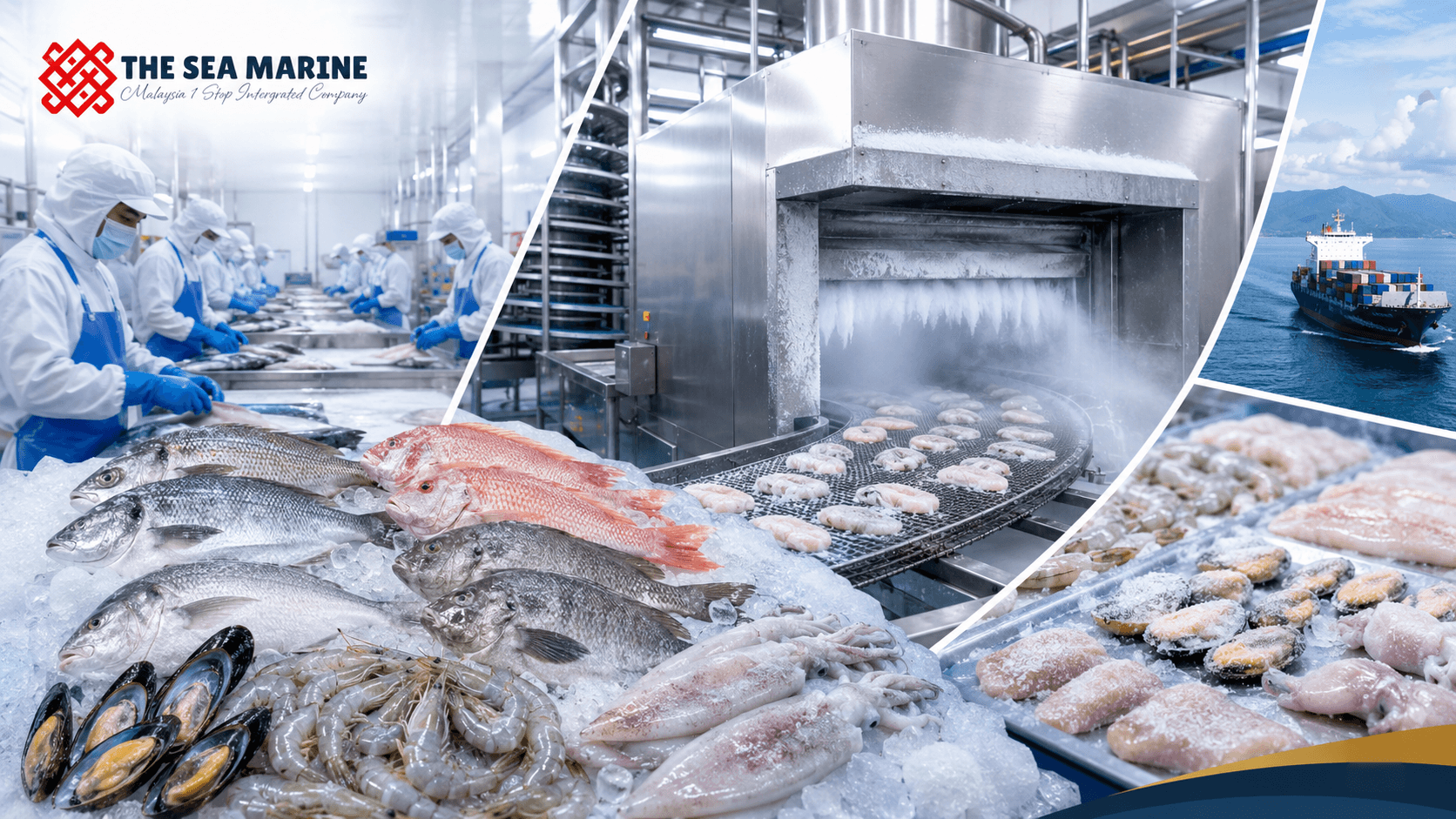
IQF Seafood Processing: How It Works and When It Is Used
Individually Quick Frozen—or IQF—seafood is frozen as separate pieces rather than as one solid block. The commercial value is portion control, easier handling and the ability to remove only the quantity required. The result still depends on raw-material condition, preparation, freezer loading, core-temperature verification, glazing, packaging and an uninterrupted frozen cold chain.
What does IQF mean?
IQF stands for Individually Quick Frozen. Seafood pieces are arranged or moved through the freezing step so they freeze separately, allowing individual prawns, fillets, portions or other suitable pieces to remain free-flowing after packing.
“Quick frozen” describes a process in which the product passes rapidly through the temperature range where most ice crystals form. Codex standards for quick-frozen fish fillets and prawns state that quick freezing is not complete until the product reaches −18°C or colder at the thermal centre after thermal stabilisation.
Why buyers choose IQF seafood
Remove only what is needed
Food-service kitchens and processors can select individual pieces without thawing an entire block.
Free-flowing product
Correctly processed IQF pieces should not be frozen together into large clumps inside the pack.
Multiple piece formats
IQF can support size-graded prawns, fish fillets, portions and other products suited to individual freezing.
How IQF seafood processing works
Equipment can include air-blast, fluidised-bed, continuous-belt or cryogenic systems. The exact time and temperature programme must match the product thickness, shape, entry temperature, loading rate and freezer capacity.
Receive & Verify
Incoming seafood is checked against the approved species, source lot, condition, temperature, quantity and product specification.
- Supplier or farm lot
- Receiving time and temperature
- Acceptance or rejection status
Prepare & Grade
The product is washed, trimmed, peeled, cut, portioned or graded according to the approved product form.
- Preparation and cut
- Size or count grade
- Bone, shell or skin condition
Chill, Drain & Separate
Product temperature and surface water are controlled before freezing. Pieces are separated so excessive contact does not create clumping.
- Pre-freeze product temperature
- Drainage and surface condition
- Uniform loading arrangement
Quick Freeze
Cold air, a fluidised bed, a continuous belt, cryogenic medium or another validated system removes heat rapidly.
- Freezer operating parameters
- Line speed or residence time
- Loading rate and product thickness
Verify Core Temperature
Representative pieces are checked to confirm that the established freezing programme has reached the required product temperature.
- Thermal-centre readings
- Calibrated measuring equipment
- Batch and operator record
Inspect Separation
The frozen product is checked for clumping, broken pieces, dehydration, incomplete freezing and other specification defects.
- Free-flowing condition
- Piece integrity
- Size and visual checks
Glaze When Specified
A controlled protective ice coating may be applied to reduce dehydration and oxidation. Water quality and declared net product weight remain important.
- Glaze method or percentage
- Potable or acceptable clean water
- Net-weight verification
Pack, Store & Ship
Product is packed promptly, identified by lot and transferred to frozen storage with controlled temperature and minimal fluctuation.
- Finished-product lot
- Pack and label version
- Cold-store and shipment records
IQF vs block-frozen seafood
Neither format is automatically superior. The correct format depends on the buyer’s thawing method, portion needs, kitchen or factory workflow, packaging, freight economics and final product.
| Factor | IQF | Block Frozen |
|---|---|---|
| Piece separation | Individual pieces should remain free-flowing | Product is frozen together as one block |
| Partial use | Suitable for removing selected quantities | Usually requires thawing the block or planned production use |
| Handling | Convenient for food service, retail and portion control | Can suit bulk, industrial or high-volume processing |
| Packaging | Bag, food-service or retail packs | Lined carton, mould or block format |
| Risk to control | Clumping, surface dehydration and incorrect glaze | Uneven thawing, block damage and handling of partial quantities |
| Buyer decision | Choose when individual-piece access creates value | Choose when production consumes a planned bulk block |
When IQF seafood is commonly used
The product must be suitable for individual freezing and the pieces must be prepared consistently enough to pass through the selected freezer.
Prawns & Shrimp
Whole, headless, peeled, deveined or cooked formats may use IQF when size grading, separation and product specification support it.
Fish Fillets
Individual fillets can support restaurant portions, distribution and pack formats where buyers do not want a solid block.
Fish Portions
Uniformly cut pieces may be suitable for food-service, retail or further processing with controlled piece weight.
Squid & Cephalopod Pieces
Rings, tubes or cut pieces may use quick-freezing systems depending on product preparation and equipment capability.
Mussel or Shellfish Meat
Suitable separated pieces may use IQF where source controls, cooking status and shell-removal specifications are defined.
Mixed Seafood Components
Separately frozen components can support controlled blending, but species, allergen, ratio and label requirements must be managed.
Malaysia and Codex requirements relevant to IQF seafood
IQF processing must operate within applicable food law, hygiene, labelling, process-control, certification and destination-market requirements.
Codex CXS 190-1995 — Fish Fillets
The standard requires rapid passage through the maximum-crystallisation range and a thermal-centre temperature of −18°C or colder after stabilisation. It also addresses glazing, labelling, net contents and storage.
View the Codex fillet standard ↗Codex CXS 92-1981 — Prawns
The standard covers quick-frozen raw, partially cooked or fully cooked prawns, peeled or unpeeled, with freezing, glazing, presentation, net-content and storage provisions.
View the Codex prawn standard ↗Codex CXC 52-2003 — Fishery Products
The code recommends freezing seafood as quickly as possible, establishing a time-temperature regime, matching production to freezer capacity, monitoring core temperature and keeping accurate freezing records.
View the Codex fishery-products code ↗Malaysia Food Hygiene Regulations 2009
Malaysia’s food-hygiene framework applies to food premises and activities including preparation, handling, storage, packaging and transport. Current requirements and amendments must be checked for the actual facility.
View Ministry of Health regulations ↗Department of Fisheries Malaysia
DOF publishes aquaculture standards and codes covering marine shrimp, marine finfish and freshwater fish production. Farm certification applies to the named operator, site and scope.
View DOF aquaculture codes ↗Malaysia Export Protocol
DOF advises exporters to confirm the importing country’s entry requirements in advance. Product eligibility, establishment approval, health documentation and labels are destination-specific.
View Malaysia export protocol ↗What an international buyer should confirm
“IQF” should not be the only line in a purchase order. The complete specification determines whether the product will perform correctly in distribution, retail, food service or further processing.
- Common and scientific species name
- Raw, cooked or partially cooked status
- Whole, peeled, fillet, portion or other product form
- Size, count or piece-weight range
- IQF system or required product presentation
- Acceptable clumping or separation standard
- Glazed or unglazed specification
- Declared net product weight
- Ingredients, additives or treatments
- Inner pack and master-carton format
- Lot code and traceability records
- Freezing and cold-storage temperature records
- Shelf life and storage instructions
- Applicable certificate holder and premises
- Destination-market label and health documents
- Sampling, inspection and claims procedure
What IQF does not solve
Rapid freezing is a preservation process. It slows deterioration once the product has been frozen correctly, but it does not reverse decomposition, remove undeclared allergens, correct the wrong species or compensate for poor sanitation.
It Does Not Sterilise
Microorganisms and some hazards may remain. Raw IQF seafood still requires the controls and cooking instructions appropriate to the product.
It Cannot Repair Raw Material
Freshness, source condition, time before freezing and handling determine what quality enters the freezer.
It Still Needs a Cold Chain
Temperature abuse, repeated thawing and refreezing, poor packaging or long exposure during loading can damage the product.
Discuss the required frozen format before ordering
Buyers should describe the commercial result they need: individually separated pieces, portion size, pack weight, food-service handling, retail presentation or industrial use. The supplier can then assess whether IQF, block freezing or another format is technically and commercially appropriate.
Review our seafood product solutions, processing facility, quality and traceability approach and export support.
Related seafood buyer resources
Frequently asked questions
Is every quick-frozen seafood product IQF?
No. Quick frozen describes the rapid freezing process. IQF also describes an individual-piece presentation in which suitable pieces remain separated instead of forming one block.
What temperature defines a completed quick-freezing process?
Codex quick-frozen fish fillet and prawn standards state that the process is not complete until the product reaches −18°C or colder at the thermal centre after thermal stabilisation.
Does IQF mean the seafood is ready to eat?
No. IQF describes freezing, not cooking status. The label and specification must state whether the product is raw, partially cooked or fully cooked.
Why do IQF pieces sometimes freeze together?
Possible causes include excess surface water, poor separation, overloading, incorrect freezer conditions, insufficient pre-cooling, glaze-related “spot welding” or temperature abuse after packing.
Is glazing required for every IQF product?
No. Glazing is a protective option that depends on the product and specification. Where used, the water quality, glaze declaration and net contents must be controlled.
What information should a buyer send for an IQF quotation?
Send the species, preparation, raw or cooked status, size, quantity, glaze, net weight, packaging, destination, certification expectations and required shipment period.
Sources used for this guide
Check the latest official version and the requirements applicable to the exact product, premises, process, certificate and destination.
- Codex CXS 190-1995 — Standard for Quick-Frozen Fish Fillets
- Codex CXS 92-1981 — Standard for Quick-Frozen Shrimps or Prawns
- Codex CXC 52-2003 — Code of Practice for Fish and Fishery Products
- Ministry of Health Malaysia — Food Hygiene Regulations 2009
- Department of Fisheries Malaysia — Aquaculture Standards and Codes
- Department of Fisheries Malaysia — Import and Export Protocol