
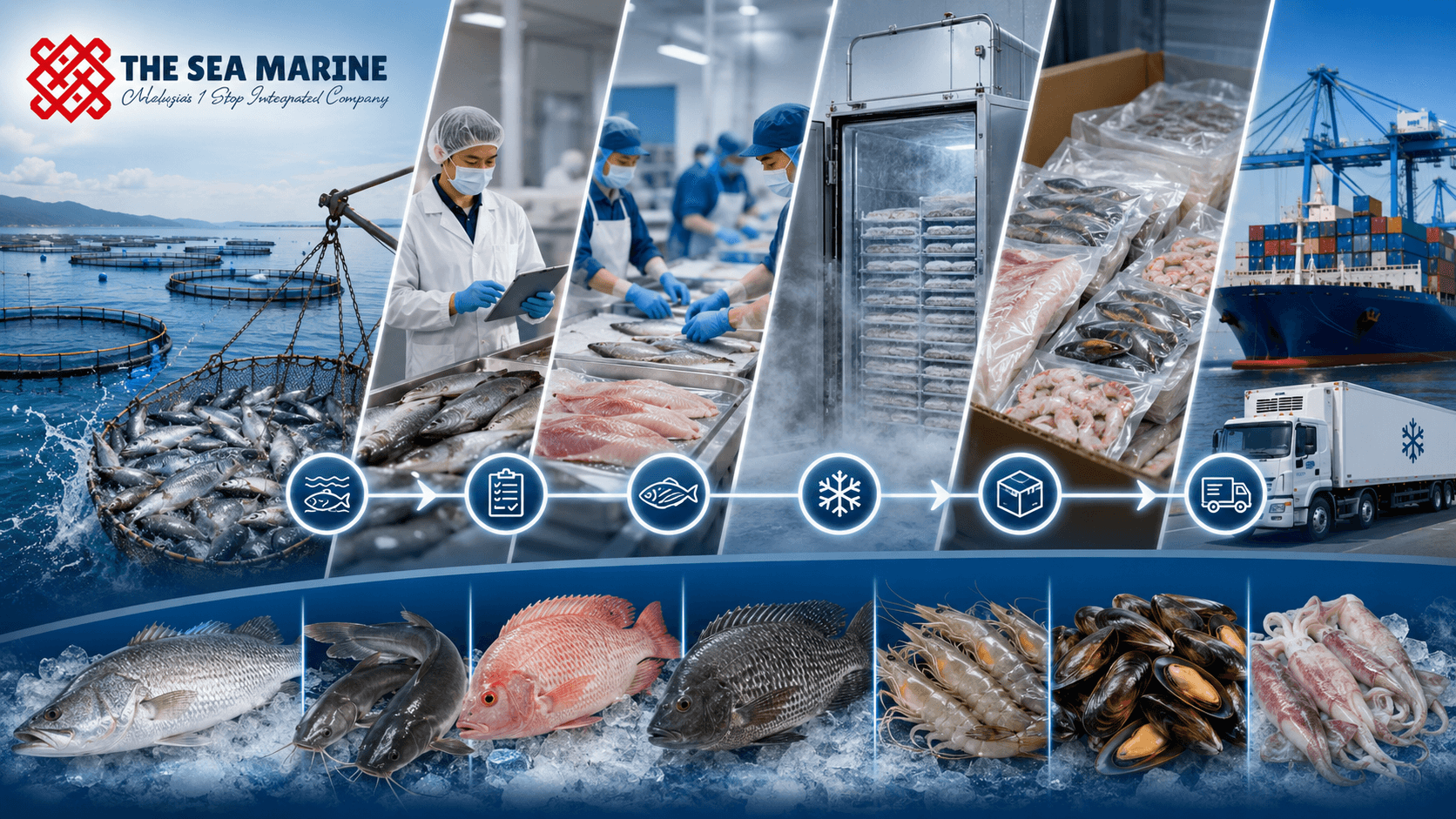
Farm-to-Freezer Seafood Traceability
Seafood traceability connects an identified farm or source lot to harvest, receiving, processing, packing, cold storage and distribution records. This guide explains what Malaysian and international buyers should expect, what records create a usable chain, and why traceability is different from certification or a general marketing claim.
What seafood traceability means
Codex defines traceability or product tracing as the ability to follow the movement of a food through specified stages of production, processing and distribution. In practical seafood operations, that means a finished carton or lot code can be connected to relevant processing and source records—and records can also show where that lot was sent.
A traceability system does not need to place every internal record on the retail label. It does need controlled identifiers, reliable record links, assigned responsibility, retention rules and a process for retrieving information quickly when a buyer, auditor or authority asks.
Why traceability matters to seafood buyers
Connect product to origin
Farm, pond, cage, hatchery, vessel or approved supplier records help support source and species verification.
Identify the affected lot
Lot records help isolate a temperature, specification, packaging or handling issue without treating all production as affected.
Support shipment evidence
Traceability can support origin, health, certification and consignment documentation where required by authorities or buyers.
The farm-to-freezer traceability chain
The exact forms and software can differ. The essential requirement is that each new identifier remains linked to the identifier and records from the previous stage.
Hatchery or Seed Source
Where relevant, hatchery and stocking records establish the livestock batch entering a farm production cycle.
- Hatchery or supplier identity
- Species and batch reference
- Delivery and stocking date
- Health or source records within scope
Farm, Pond or Cage
The farm record connects the stocked batch to a defined production unit and its operating history.
- Farm and pond or cage ID
- Stocking, feed and treatment records
- Water-quality and mortality records
- Applicable certification site details
Harvest Lot
A harvest lot should identify what was harvested, from where, when, in what quantity and under whose control.
- Harvest lot number
- Date, time and production unit
- Species, estimated size and quantity
- Harvest handling and dispatch information
Transport & Receiving
Receiving records connect the harvest lot to the processing facility and document condition at transfer.
- Vehicle or transporter reference
- Dispatch and receiving time
- Temperature or ice condition
- Received quantity and acceptance status
Processing Batch
The processing batch links source lots to grading, preparation, freezing and production-control records.
- Processing batch or work-order ID
- Source harvest lot references
- Product form and specification
- Production date, line and verification records
Packing & Finished Lot
The finished lot code should connect the packed product to the processing batch, pack format and label version.
- Finished-product lot code
- Net weight, pack and carton configuration
- Label or private-label version
- Storage location and release status
Shipment & Customer
Distribution records show which finished lots were included in each order, container or delivery.
- Customer and sales-order reference
- Invoice, packing list and shipment ID
- Lot quantities loaded
- Export certificates or origin records where applicable
A useful system links identifiers—not just folders of documents
A business may keep many records and still have weak traceability if the identifiers do not connect. Each stage should carry forward enough information to reconstruct the lot history without relying only on staff memory.
| Stage | Primary identifier | Must link backward to | Must link forward to |
|---|---|---|---|
| Farm | Pond, cage or production-unit ID | Seed or stocking batch | Harvest lot |
| Harvest | Harvest lot number | Farm and production unit | Transport and receiving record |
| Receiving | Receiving or intake number | Harvest lot and transporter | Processing work order |
| Processing | Batch or work-order number | One or more source lots | Finished-product lot |
| Packing | Finished-product lot code | Processing batch and label version | Storage and shipment record |
| Shipment | Sales order, delivery or container ID | Finished lots loaded | Customer or importer destination |
Malaysia and Codex traceability framework
The following references explain why records, source evidence and product tracing matter. Their application depends on the actual operation, certificate and destination.
Department of Fisheries Malaysia — myGAP
Malaysia’s aquaculture myGAP criteria include updated farm records, harvest handling, biosecurity, record keeping and traceability requirements. Certification applies to the named premises and scope.
View official myGAP information ↗Fish Quality Certification — FQC
DOF describes FQC as a scheme covering relevant actors across the fish supply chain for EU export, with monitoring and source-reference controls. It should not be claimed without a current certificate for the applicable entity and premises.
View official FQC information ↗Malaysia Export Support Documents
DOF’s export-support services list fish or shrimp traceability documents, certificates of origin and other product-specific supporting documents. Requirements depend on the product and destination.
View export-support services ↗Malaysia Food Hygiene Regulations 2009
Food-premises controls cover preparation, handling, storage, packaging and transport. Traceability records should operate together with hygiene, temperature and product-control records.
View Ministry of Health regulations ↗Codex CXG 60-2006
Codex principles position traceability or product tracing as a tool within food inspection and certification systems. It should have a clear objective, defined scope and practical application.
View Codex traceability guidance ↗Codex CXC 52-2003
The Code of Practice for Fish and Fishery Products provides process and HACCP guidance across aquaculture, harvest, receiving, processing, freezing, storage and distribution.
View the Codex fishery code ↗What an international seafood buyer should request
The buyer does not necessarily need every confidential farm or production record before ordering. The buyer should understand what evidence can be provided, how lots are identified and how an investigation would be handled.
- Common and scientific species name
- Farmed or captured source declaration
- Applicable farm, supplier or premises reference
- Harvest date or source-lot reference
- Processing and finished-product lot code
- Product specification and pack format
- Production, freezing and packing date
- Cold-storage and shipment temperature records
- Certificate holder, site, scope and validity
- Certificate of origin where required
- Health or export-support documents where required
- Lot-based complaint and recall procedure
- Record-retention period
- Contact person responsible for traceability
Traceability must work in both directions
Backward tracing identifies where the affected product came from. Forward tracing identifies which customers, orders or shipments received the lot. Internal tracing connects transformations such as one harvest lot being split into several processing batches or several source lots being combined under controlled production.
One Step Back
Identify the immediate source, source lot, date, quantity and supporting documents.
Internal Link
Connect receiving, processing, rework, packing, storage and quantity reconciliation.
One Step Forward
Identify every customer, shipment and quantity that received the affected finished lot.
Building traceability across an integrated supply chain
The Sea Marine’s group structure connects hatchery support, farm inputs, grow-out operations, harvesting, transport, processing, packing and commercial supply. The practical objective is to maintain usable links between those activities when they apply to the specific product and order.
Buyers should still verify which legal entity, farm, premises and certification scope apply. Group integration should improve coordination; it should not be used to imply that one certificate automatically covers every company or facility.
Explore our quality and traceability approach, processing facility and export support.
Related seafood buyer resources
Frequently asked questions
Is seafood traceability the same as myGAP certification?
No. Traceability is a record and identification capability. myGAP is a certification scheme with defined criteria, audits, premises and validity. Traceability is one of the relevant control elements.
What should a finished seafood lot code identify?
The format is company-specific, but the code should connect to the processing batch, source lots, production or packing date, product specification, pack version, release status and shipment records.
Can several farms be included in one processing batch?
It may be operationally possible where permitted, but every contributing source lot and quantity must remain identifiable. Combining sources increases the scope of any investigation or recall.
Does blockchain automatically create compliant traceability?
No. Technology can store or share records, but poor source data remains poor data. Clear identifiers, verified entries, responsibilities and reconciliation matter more than the software label.
How long should seafood traceability records be kept?
The retention period should follow applicable Malaysian law, certification rules, destination requirements, customer contracts, shelf life and the organisation’s documented programme. A single universal period should not be assumed.
What should a buyer include in an enquiry?
State the species, product form, quantity, packaging, destination, certification expectations, required origin or health documents, lot-information needs and any customer traceability standard.
Sources used for this guide
Check current official versions and the rules applicable to the exact product, company, premises, certification and destination.
- Department of Fisheries Malaysia — Aquaculture myGAP Certification
- Department of Fisheries Malaysia — Fish Quality Certification
- Department of Fisheries Malaysia — Export Support Certificates and Traceability Documents
- Ministry of Health Malaysia — Food Hygiene Regulations 2009
- FAO — Traceability and Recalls
- Codex CXG 60-2006 — Principles for Traceability / Product Tracing
- Codex CXC 52-2003 — Code of Practice for Fish and Fishery Products